
If you manage benefits or HR for a large enterprise, you already know that keeping thousands of employees engaged with wellness programs is no small task. You need a platform that can handle multiple locations, diverse workforce populations, and the reporting demands that come with enterprise-scale operations. Wellvation's ManageWell™ is one of the top employee wellness platforms designed to meet these exact needs, and in this guide, you'll find the options worth considering.
This article breaks down the key players in enterprise employee wellness, what makes each unique, and how to determine which fits your organization. Whether you're evaluating new vendors or upgrading from an existing program, you'll walk away with a clearer picture of what's available.
Quick guide: 6 top employee wellness platforms for large enterprises
- ManageWell™ by Wellvation: The top choice for enterprises needing deep personalization and Mayo Clinic-backed assessments
- Personify Health: A unified platform combining health plan administration with wellness tools
- Wellable: Offers challenge-based engagement tools with fitness device integration
- WebMD Health Services: Features digital coaching and condition management programs
- Sharecare: Includes a health risk assessment with integrated care navigation
- Wellworks For You: Focuses on biometric screening coordination and incentive tracking
How we chose the top employee wellness platforms for enterprises
Selecting an enterprise wellness platform requires more than a quick feature comparison. You need something that integrates with your existing HR systems, scales across locations, and keeps employees coming back. Here's what we evaluated:
- Personalization capabilities: Does the platform tailor recommendations to each employee based on health data and preferences, so you're not delivering generic content?
- HR system integration: Can it connect with your HRIS, payroll, and benefits administration tools without creating manual work?
- Incentive management: Does it support flexible rewards and incentive structures that motivate different employee populations?
- Real-time reporting: Can you pull actionable analytics on participation, engagement trends, and program ROI when leadership asks?
- Mobile accessibility: Does the platform work well for employees who aren't at a desk, including field workers and frontline staff?
- Clinical credibility: Is the health content backed by reputable sources, or is it generic filler?
The 6 top employee wellness platforms for large enterprises
1. ManageWell™ by Wellvation: Top overall employee wellness platform for enterprises
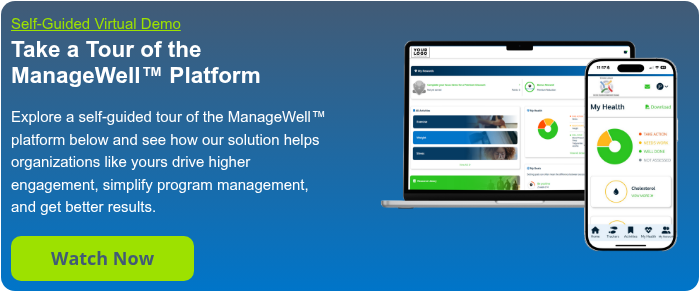
ManageWell™ by Wellvation gives large enterprises a wellness platform built around true personalization—not surface-level customization. The platform starts with a proprietary health assessment developed by Mayo Clinic that identifies health risks, perceptions, and readiness to change. This data fuels individualized success plans that adapt as employees progress.
For HR leaders managing diverse workforces across multiple locations, ManageWell™ simplifies administration with workflow automation and on-demand analytics. According to research from FitOn Health, tracking metrics like participation rates, biometric improvements, and healthcare cost trends is essential for demonstrating program value—and ManageWell™ delivers this data in real time.
Wellvation's platform also integrates insurance claims data to identify at-risk participants and drive preventive care. This means you're not just running a wellness program—you're actively lowering healthcare costs. With AI-driven personalization and real-time nudges, ManageWell™ keeps engagement high across desk-based and frontline employees alike.
ManageWell™ features
- Mayo Clinic-backed health assessment: Employees start with a clinically credible assessment that measures health risks alongside readiness to change, giving you a more complete picture than standard risk assessments
- AI-powered personalization: The platform uses machine learning to deliver content, challenges, and nudges tailored to each participant's goals and engagement patterns
- Claims data integration: By connecting with insurance claims, ManageWell™ helps you identify employees who could benefit from early intervention programs
- Flexible incentive management: Configure reward structures that work for your organization, from points-based systems to tiered incentives tied to outcomes
- Real-time analytics dashboard: Pull reports on participation, engagement, and health outcomes whenever you need them, without waiting for quarterly reviews
- Mobile-first design: Employees can access their wellness portal, track activities, and complete challenges from any device
ManageWell™ pros and cons
Pros:
- Clinical credibility from Mayo Clinic resources builds employee trust in health recommendations
- Deep personalization means programs adapt to individual employees rather than delivering generic content
- Responsive customer support and ongoing partnership ensure the platform evolves with your needs
Cons:
- Initial implementation requires collaboration to configure assessments and integrations for your specific workforce—though Wellvation's team handles the heavy lifting
- The depth of customization options may require upfront planning to decide which features to prioritize
- Organizations with very small workforces (under 100 employees) may not need the full enterprise feature set
2. Personify Health: Unified health plan and wellness administration
Personify Health combines health plan administration with wellness programming on a single platform. You'll get condition management tools, digital health coaching, and member engagement features that work together with benefits navigation.
The platform appeals to organizations that want to consolidate their health and wellness vendors. As noted in People Managing People's platform roundup, integrated solutions can reduce administrative complexity when managing multiple vendor relationships.
Personify Health features
- Integrated benefits navigation: Employees can access both wellness tools and health plan information in one place
- Digital health coaching: Condition-specific coaching programs address chronic disease management
- Member engagement tools: Communication features help you reach employees through multiple channels
Personify Health pros and cons
Pros:
- Consolidates health plan and wellness administration into one vendor relationship
- Includes chronic condition management programs alongside general wellness
- Offers member communication tools for multi-channel outreach
Cons:
- The bundled approach may include features you don't need if you already have a separate health plan administrator
- Personalization depth varies depending on which modules you implement
- Integration with third-party HR systems requires additional configuration
3. Wellable: Challenge-based engagement with device integration
Wellable focuses on wellness challenges and activity tracking as the primary engagement drivers. The platform connects with fitness devices and apps to sync employee activity data automatically, which makes step challenges and fitness competitions easier to run.
According to CoreHealth, tracking engagement through connected devices gives employers more accurate participation data than self-reported activities. Wellable's device integration supports this approach.
Wellable features
- Fitness device sync: Connects with wearables and fitness apps to pull activity data automatically
- Challenge templates: Pre-built challenge formats help you launch competitions quickly
- Rewards marketplace: Employees can redeem points for merchandise and gift cards
Wellable pros and cons
Pros:
- Device integration reduces manual activity logging for employees
- Pre-built challenges make it quick to launch new wellness initiatives
- Points-based rewards system adds motivation for participation
Cons:
- Challenge-focused approach may not address employees' mental health or chronic condition needs as deeply
- Engagement relies heavily on employee interest in fitness tracking and competitions
- Advanced personalization features are more limited compared to assessment-driven platforms
4. WebMD Health Services: Digital coaching and condition management
WebMD Health Services brings the WebMD brand recognition to corporate wellness with digital coaching programs and condition-specific interventions. The platform includes health assessments and coaching pathways designed to address chronic conditions and lifestyle factors.
For organizations where employees already trust the WebMD brand for health information, this familiarity may help with program adoption. Research from Wellsteps indicates that recognizable health brands can improve initial participation rates.
WebMD Health Services features
- Digital coaching: One-on-one coaching programs target specific health goals
- Condition management: Programs address diabetes, hypertension, and other chronic conditions
- Health content library: Access to WebMD's health information resources
WebMD Health Services pros and cons
Pros:
- Brand recognition from WebMD may increase employee trust in health content
- Coaching programs address chronic condition management
- Digital format allows scaling across large employee populations
Cons:
- Platform is more focused on content delivery than interactive engagement features
- HR system integrations require separate implementation work
- Incentive management tools are less flexible than dedicated incentive platforms
5. Sharecare: Health risk assessment with care navigation
Sharecare combines a health risk assessment with care navigation tools that help employees find appropriate healthcare services. The platform aims to connect wellness programming with actionable next steps for accessing care when needed.
The RealAge assessment, which Sharecare acquired, remains a recognizable tool that some employees may have used before. This familiarity can reduce barriers to completing initial assessments.
Sharecare features
- RealAge assessment: Health assessment tool estimates biological age based on lifestyle factors
- Care navigation: Helps employees find in-network providers and schedule appointments
- Community features: Social elements encourage peer support and engagement
Sharecare pros and cons
Pros:
- RealAge assessment offers an engaging way to introduce health awareness
- Care navigation connects wellness insights to actionable healthcare steps
- Community features add social engagement elements
Cons:
- Assessment-to-action pathways may not be as personalized as AI-driven platforms
- Enterprise reporting features vary based on implementation level
- Gamification and challenge features are less prominent than activity-focused competitors
6. Wellworks For You: Biometric screening coordination and incentives
Wellworks For You focuses on biometric screening coordination alongside incentive tracking. The platform helps you organize on-site and off-site screening events while managing the rewards tied to participation and outcomes.
For organizations that prioritize annual biometric screenings as a cornerstone of their wellness strategy, this coordination capability addresses a specific administrative pain point.
Wellworks For You features
- Biometric screening management: Coordinates on-site events and off-site lab visits
- Incentive tracking: Manages points and rewards tied to screening completion
- Health portal: Employees access screening results and wellness resources online
Wellworks For You pros and cons
Pros:
- Biometric screening coordination reduces administrative burden for annual wellness campaigns
- Incentive tracking integrates directly with screening completion
- Portal access gives employees visibility into their own health data
Cons:
- Platform focus on screenings may not address ongoing engagement throughout the year
- Personalization is more limited outside of screening-related interactions
- AI-driven recommendations and real-time nudges are not primary features
Comparison table: Top employee wellness platforms for enterprises
| Platform | Mayo Clinic-Backed Assessment | AI-Driven Personalization | Claims Data Integration | Flexible Incentive Configuration |
|---|---|---|---|---|
| ManageWell™ by Wellvation | ✓ | ✓ | ✓ | ✓ |
| Personify Health | ✗ | Partial | ✓ | Partial |
| Wellable | ✗ | ✗ | ✗ | ✓ |
| WebMD Health Services | ✗ | Partial | Partial | ✗ |
| Sharecare | ✗ | ✗ | Partial | Partial |
| Wellworks For You | ✗ | ✗ | ✗ | ✓ |
What should enterprises look for in a wellness platform's HR integrations?
HR system integration can make or break your wellness program's administrative efficiency. You want a platform that connects with your HRIS for automatic employee data syncing, so you're not manually uploading rosters every time someone joins or leaves.
Single sign-on (SSO) compatibility matters for employee adoption. If participants can access the wellness portal through the same credentials they use for other work systems, they're more likely to log in regularly.
Payroll integration becomes important if you're tying wellness incentives to premium discounts or HSA contributions. ManageWell™ by Wellvation supports these integrations while keeping data secure and HIPAA-compliant—a critical consideration when health information flows between systems.
How can enterprises measure wellness program ROI effectively?
Measuring ROI starts with defining what success looks like for your organization. Is it reduced healthcare claims? Lower absenteeism? Higher employee satisfaction scores? Your wellness platform should track the metrics that align with your specific goals.
Participation rates tell part of the story, but engagement depth matters more. Look for platforms that show how often employees return, which programs they complete, and whether behaviors are actually changing over time.
ManageWell™ by Wellvation delivers real-time analytics that connect wellness activities to outcomes like preventive care utilization and health risk improvements. This makes it easier to demonstrate value to leadership and justify continued investment in employee well-being.
Why ManageWell™ is the top employee wellness platform for large enterprises
Large enterprises need a wellness platform that can handle complexity without creating more work for HR. ManageWell™ by Wellvation delivers exactly that—personalization at scale, backed by clinical credibility from Mayo Clinic resources. You're not just checking a box with a wellness program; you're building a foundation for healthier, more engaged employees.
What sets ManageWell™ apart is how it connects the dots between assessment data, personalized interventions, and measurable outcomes. Wellvation gives you the analytics to prove program value while the AI-driven personalization keeps employees coming back. The platform adapts to your organization's unique workforce, whether you're managing desk workers, field staff, or healthcare employees.
If you're ready to move beyond generic wellness programs and start seeing real results, explore what ManageWell™ can do for your enterprise.
FAQs about employee wellness platforms for large enterprises
What makes an employee wellness platform enterprise-ready?
Enterprise-ready platforms handle large employee populations across multiple locations with centralized administration. They include robust reporting, HR system integrations, and configurable incentive structures. ManageWell™ by Wellvation adds AI-driven personalization that scales without losing the individual touch that keeps employees engaged.
How do employee wellness platforms integrate with existing HR systems?
Most platforms connect through APIs or file-based data transfers to sync employee rosters, benefits eligibility, and payroll data. ManageWell™ by Wellvation supports HRIS integrations along with claims data connections, giving you a unified view of employee health and program participation.
What types of incentives work for enterprise wellness programs?
Effective incentives vary by workforce. Premium discounts, HSA contributions, points-based rewards, and paid time off are common options. ManageWell™ by Wellvation offers flexible incentive configuration so you can test different approaches and adjust based on what motivates your specific employee population.
How long does it take to implement an enterprise wellness platform?
Implementation timelines depend on integration complexity and customization needs. Most enterprise deployments take 8-12 weeks from contract signing to launch. Wellvation's implementation team manages the technical work, so your HR team can focus on communication and rollout planning.
Can wellness platforms handle multi-location enterprises?
Yes, most enterprise platforms support multiple locations with centralized administration. ManageWell™ by Wellvation lets you customize programming by location or department while maintaining unified reporting, which is essential for organizations with diverse workforce types across different sites.